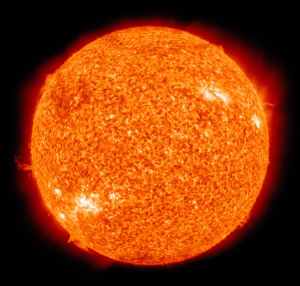
Do you like making sandcastles at the beach or watching a rainbow? How about summer vacation? All these things are made possible by the Sun. The Sun is a star made of burning gases. It is closer to us than any other star. The Sun controls our seasons. It even controls when we are asleep and awake.
Many ancient cultures thought the Sun was a god. The term ‘solar’ is derived from the ancient Roman word ‘Sol’ which means the Sun god.
Don’t look directly at the Sun, which can hurt your eyes. Scientists study the Sun through specially filtered telescopes. The safest way to observe the Sun is by projecting it on a surface.
The Sun is the largest thing in our solar system. It formed nearly 4.5 billion years ago. Our earth rotates around its own axis and also revolves around the Sun. Just like our earth, the Sun also rotates around its own axis and revolves around the center of our galaxy. Since the Sun is made of gases and does not have any solid crust, the way it rotates is very different from the way earth or other rocky planets rotate. Its polar regions rotate slowly compared to its middle region known as the equatorial region. It only takes the earth one year to complete an orbit around the Sun, but scientists estimate that it will take the Sun about 230 million years to complete one rotation around the center of the galaxy.
The Sun is the closest star to the earth. Compared to other stars, the Sun is medium in size. Our galaxy has billions of stars like our Sun and many of these stars are much bigger than our Sun. The Sun is considered to be a yellow dwarf star and its size is increasing slowly.
The Sun is 100 times wider than the earth. More than a million Earths can fit inside the Sun. The Sun is very far from us. If we start traveling to the Sun in a car, then it will take us nearly 170 years to reach the Sun but the Sunlight reaches the earth in just 8 mins and 20 seconds from the time it leaves the surface of the Sun.
The Sun is the center of our solar system. All the planets in our solar system revolve around the Sun. The gravitational power of the Sun makes our earth and other planets go around the Sun. Without the gravity of the Sun, the earth will go off spinning into space. The Sun holds our solar system together.
Sun gives us heat and light. There exists life on the earth because of the Sun. How does the Sun generate so much light and heat? Well, the Sun is a giant ball of gas, mostly hydrogen and little helium and traces of some other elements. The gasses in the Sun are held together by its gravity which creates intense heat and pressure in the core of the Sun. The temperature at the core of the Sun is nearly 15 million degrees celsius. This intense heat and pressure in the core of the Sun cause nuclear fusion which converts hydrogen to helium deep in the Sun’s core. This process of nuclear fusion creates the heat and light that we receive from the Sun.
The energy created by nuclear fusion travels to the Sun’s surface in a journey that lasts a million years. But once this energy reaches the surface of the Sun, part of it escapes in the form of Sunlight and it takes only eight minutes and 20 seconds for the light leaving the Sun to reach Earth. The light from our next closest star, Proxima Centauri, takes more than four years to reach Earth!
The Sun sends us more than just heat and light; it sends lots of other energy and small particles our way. Sun’s hot corona shoots out tiny bits of matter, or particles, that carry an electric charge. A stream of these particles is called the solar wind. The protective magnetic field around Earth shields us from most of the energy and particles, and we don’t even notice them. But at the polar region, the magnetic field is weak and so the particles enter the Earth’s atmosphere at the polar regions and cause colorful bands of light called auroras to appear in the sky in Earth’s far northern and southern regions.
Some areas on the Sun’s surface are cooler than others. These areas look darker. They are called ‘Sunspots’.
Sometimes gases on the Sun’s surface erupt, shooting far out into space. These are known as solar flares. Solar flares typically occur near Sunspots. They send a tremendous amount of charged particles and energy into Earth’s atmosphere. These eruptions look beautiful, but they can cause problems here on Earth. They can interfere with satellites. Our cell phones and televisions might not work.
But the Sun doesn’t send the same amount of energy all the time. The Sun does not have a solid crust like earth, instead, it has a gassy surface that is constantly changing and moving. There is a constantly streaming solar wind and there are also solar storms. During one kind of solar storm called a coronal mass ejection (CME), the Sun sends out a huge bubble of electrified gas that can travel through space at high speeds. Just like solar flares, CMEs can interfere with our satellites and telecommunication and they can also affect our power grids and cause blackouts.
Sun has several layers. The 3 inner layers of the Sun are Core, Radiative zone, and Convection zone. The inner layers of the Sun are covered by the solar atmosphere. The solar atmosphere is made up of 4 layers:
- The Photosphere: It is the visible surface of the Sun. Most of the visible light comes from the photosphere.
- The Chromosphere: It is an irregular layer above the photosphere where the temperature rises from 6000°C to about 20,000°C.
- Transition Region: It is a thin and very irregular layer of the Sun’s atmosphere that separates the hot corona from the much cooler chromosphere.
- The Corona: It is the outermost layer of the solar atmosphere.
Among the outer layers, the temperature goes on increasing as we move away from the inner layers towards the surface of the Sun. So the temperature of the chromosphere is higher than the temperature of the photosphere and the temperature of Corona is higher than the temperature of the chromosphere. The chromosphere and the corona are visible only during a solar eclipse.
The energy that we get from the Sun is known as ‘Solar Energy’. We can use solar energy to generate electricity, heat water, and cook food. Plants use the Sun’s energy in a process called photosynthesis which produces food and oxygen.
Without the Sun, Earth will be a cold frozen planet with no life on it. The energy that we receive from the Sun is generated by the Sun by converting hydrogen to helium but the hydrogen available in the core of the Sun is limited and eventually one day, the Sun will run out of hydrogen and will stop shining! But don’t worry, that day is still billions of years away.


 Curious Kids
Leave a comment